Quick actions
Tap to jump. Use only if it is safe.
Most important
Keep the door closed. Do not consent to entry. Ask for a warrant signed by a judge.
Short scripts
- I do not consent to entry.
- Do you have a warrant signed by a judge?
- Slide it under the door or hold it to the window.
- I choose to remain silent.
If someone was detained
Call for support and referrals. Calling does not guarantee representation.
- Los Angeles Rapid Response Network: 888 624 4752
- ImmDef rapid response legal resource hotline: 213 833 8283 Monday to Friday, 9 AM to 4 PM
- LA County Office of Immigrant Affairs: 800 593 8222
Core rights, quick version
- You can remain silent.
- You can refuse consent to a search.
- You can ask: Am I free to leave?
- Do not physically resist. Say: I do not consent.
- If it is safe, record from a respectful distance and do not interfere.
Use these steps only when it is safe. This site is general information, not legal advice.
Sources, plain text
Reference names only. For clickable links, use the Sources tab.
- California Collaborative for Immigrant Justice, Rapid Response hotlines
- Immigrant Defenders Law Center, ImmDef Rapid Response hotline
- CHIRLA, contact and legal services
- CARECEN, legal services
- Esperanza Immigrant Rights Project
- Public Counsel, Immigrants’ Rights Project
- LAFLA, Legal Aid Foundation of Los Angeles
- Advancing Justice SoCal, immigration
- LA County Office of Immigrant Affairs
- ILRC Red Cards
- NILC, Know Your Rights guides
- ACLU, filming and photographing police
- ICE Online Detainee Locator and USA.gov detainee locator guide
- US Courts AO 93 warrant form
- Key cases: Riley v. California, Pennsylvania v. Mimms, Maryland v. Wilson
- California Penal Code 632 and 148(a)(1)
Quick actions
Tap to jump. Use only if it is safe.
More nonprofit immigration legal help in Los Angeles
Capacity changes. Call and ask about eligibility and appointments. Avoid “notarios” or immigration consultants who are not authorized.
- CHIRLA legal services: (213) 353-1333 (appointments). Immigrant assistance line: (888) 624-4752.
- CARECEN: (213) 385-7800 ext. 136 (schedule a consultation).
- Esperanza Immigrant Rights Project: (213) 251-3505 (Mon–Fri, 9 AM–5 PM).
- Public Counsel, Immigrants’ Rights Project: (213) 385-2977 (appointment only).
- LAFLA intake: (800) 399-4529 (eligibility varies).
- Advancing Justice SoCal helplines for detained loved ones: English (888) 349-9695 and other language lines.
- KIND, Kids in Need of Defense (children): (213) 274-0170.
- LACBA Immigration Legal Assistance Project: (213) 485-0143 (appointments) and (213) 485-1873 (intake).
- Al Otro Lado: (323) 238-9935 (listed as an LA County provider).
- LA County Office of Immigrant Affairs: (800) 593-8222 (services and referrals, also reports immigration fraud).
Red card
Printable “know your rights” cards can help you assert rights without speaking much.
Download LA Rights Guide pocket card PDFTip: If you are inside your home, you can show a card through a window or slide it under the door without opening.
Trusted websites and directories
- ILRC Red Cards printable know your rights cards in multiple languages.
- NILC know your rights guides for ICE encounters.
- ACLU filming and photographing police, and general know your rights.
- ICE Detainee Locator to find someone in ICE custody.
- Immigration Advocates National Immigration Legal Services Directory.
- LawHelpCA California legal aid listings and self help resources.
If you suspect immigration fraud
Los Angeles help lines
Use these for referrals, reporting enforcement activity, or support when someone is detained.
- Los Angeles Rapid Response Network: 888 624 4752
- ImmDef rapid response legal resource hotline: 213 833 8283 Monday to Friday, 9 AM to 4 PM
- LA County Office of Immigrant Affairs: 800 593 8222
- Boyle Heights local line: 323 805 1049
What to have ready
- Full name and date of birth.
- City where the detention or contact occurred.
- If known, the A number.
- A safe call back number.
What to write down after, if safe
Recording safely, if it is safe
- You generally have a right to record law enforcement in public spaces. Do it only when it is safe.
- Record from a respectful distance. Do not interfere. Do not cross barriers or police lines.
- If an officer tells you to step back for safety or to keep an area clear, step back and keep recording from farther away.
- Do not physically resist. Do not argue at the scene. Keep hands visible and stay calm.
- California has strict rules about recording confidential conversations. Avoid recording private conversations where people reasonably expect privacy.
Protect your video so it is not lost
If your phone is lost, damaged, or taken, the safest plan is to get a copy off the device quickly.
- Fastest: Send the video to a trusted person right away by text or secure messaging.
- Cloud backup: Turn on automatic photo and video backup (iPhone iCloud Photos, or another cloud service you already use).
- Share a link: Upload to a cloud drive and share a private link with a trusted contact.
- Account safety: Use a strong password and turn on two factor authentication.
- Privacy: Think before posting publicly. Public posts can expose faces, addresses, and location data.
Minimum settings
- Phone passcode on.
- Cloud backup on, or send to a trusted person.
- Two factor authentication on your cloud account.
Quick scripts while recording
- I am recording from a safe distance. I am not interfering.
- I will step back. I do not consent to any search of my phone.
- Date and time.
- Agency, for example ICE, DHS, police.
- Names and badge numbers if visible.
- What document was shown, photo only if safe.
- What was said, what happened, who witnessed.
Quick actions
Tap to jump. Use only if it is safe.
At home
Keep the door closed. Do not consent to entry.
Common ways officers enter
- You give consent.
- A judicial warrant signed by a judge.
- A narrow emergency exception, such as immediate danger or hot pursuit.
If they claim an emergency
Door script
If it is safe, you can record
- Record through a window or from behind a closed door.
- Keep your voice calm. Do not open the door just to record.
- Save the file quickly using the backup steps in the LA help tab.
- I do not consent to entry.
- Do you have a warrant signed by a judge?
- Slide it under the door or hold it to the window.
- I choose to remain silent.
If they enter anyway
Quick actions
Tap to jump. Use only if it is safe.
Warrant check, 10 seconds
Look for simple visual clues. Real documents vary.
A judicial warrant often has
- A court name at the top.
- A judge or magistrate signature.
- A case number and date.
- If it is a search warrant, your exact address.
An ICE administrative warrant often has
- DHS or ICE at the top.
- A form line, often I 200 or I 205.
- An immigration officer signature, not a judge.
Sample judicial warrant, court
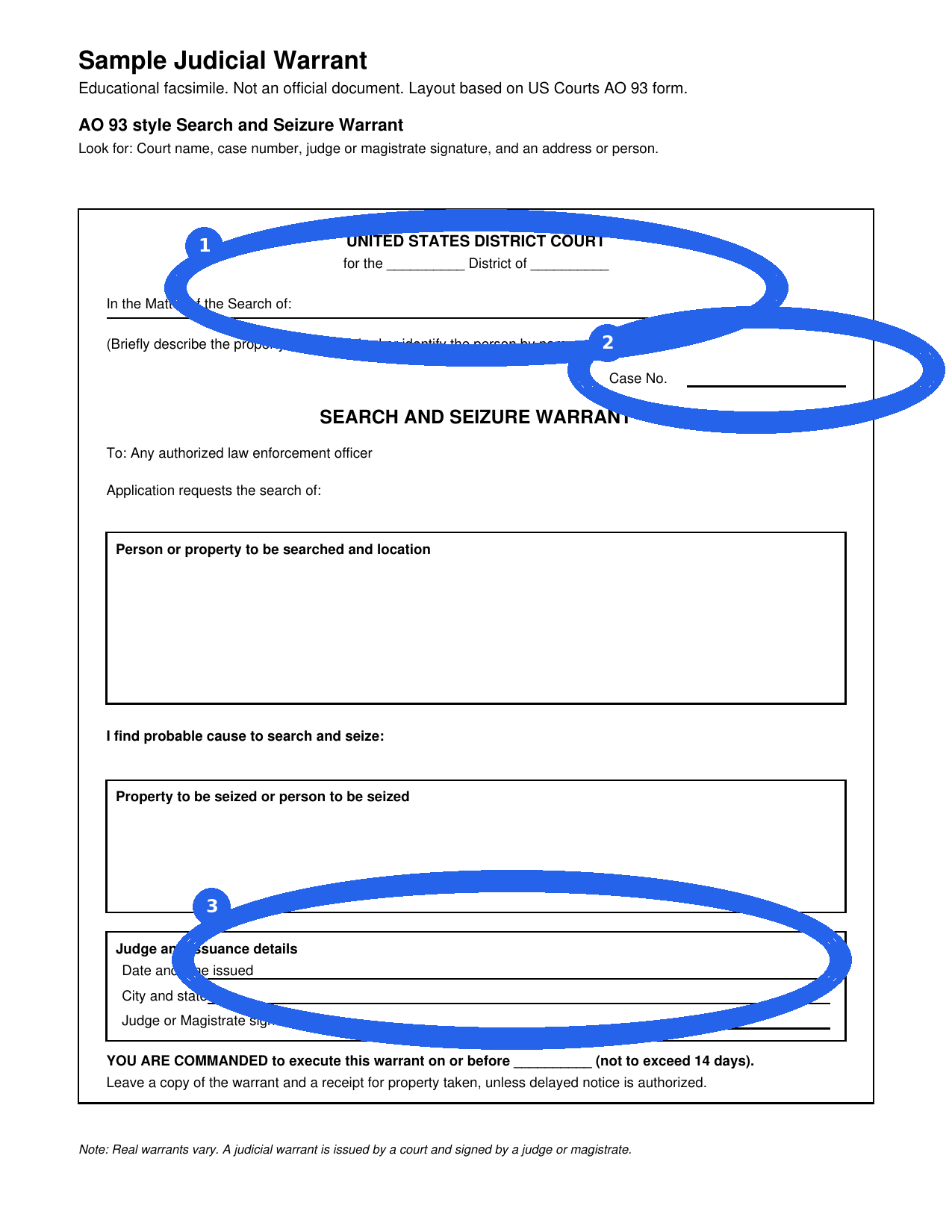
Circle 1 court. Circle 2 case number. Circle 3 judge signature.
Sample ICE administrative warrant
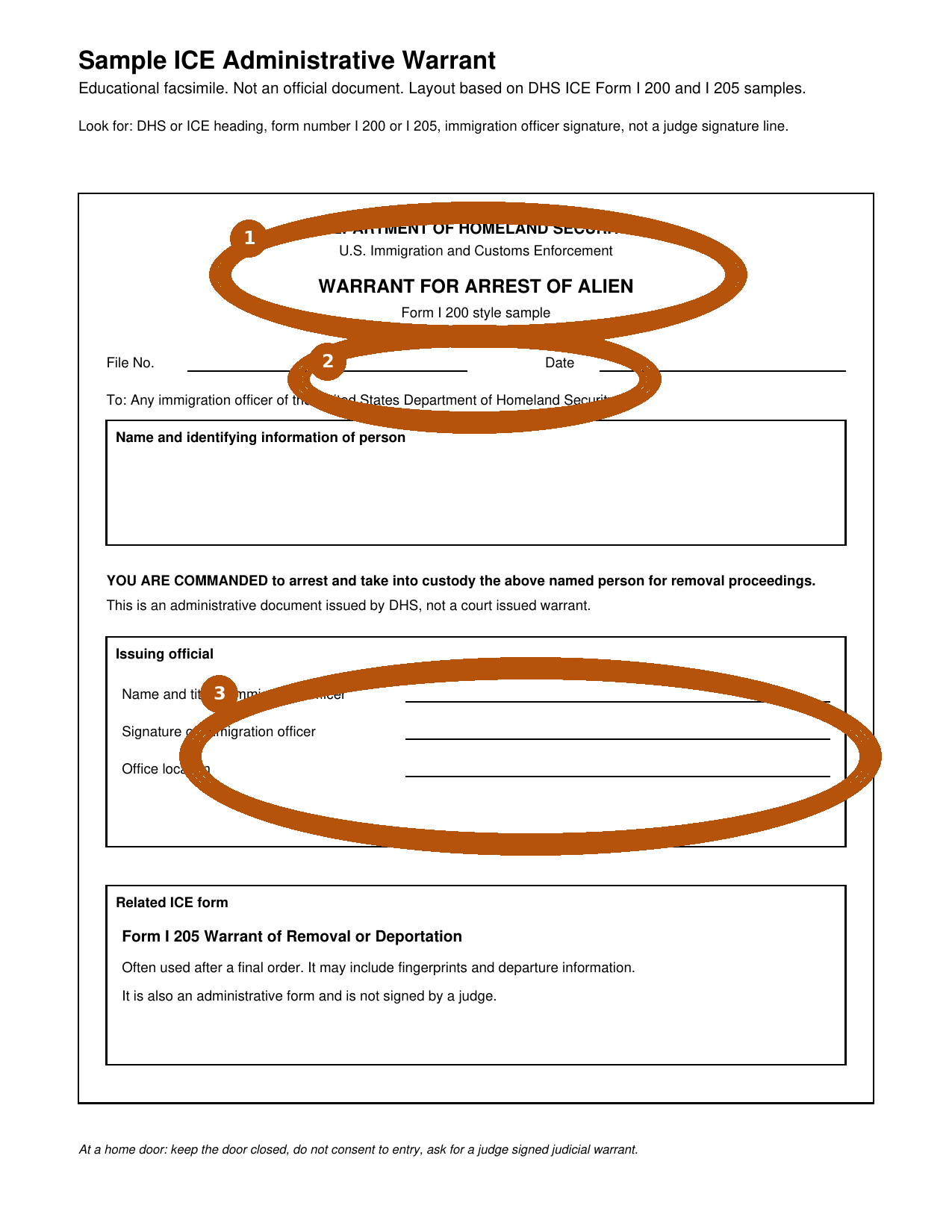
Circle 1 DHS or ICE heading. Circle 2 form line. Circle 3 officer signature.
Helpful tip
You can ask officers to hold the document to a window or slide it under the door so you can read it without opening.
Download full samples, PDFQuick actions
Tap to jump. Use only if it is safe.
On the street
- Stay calm. Hands visible.
- Ask: Am I free to leave? If yes, leave calmly.
- You can remain silent.
- Say: I do not consent to a search.
- Do not run. Do not resist.
Stopped while commuting, going to or from work
Same basics apply on the sidewalk, at a bus stop, leaving a job site, or walking home.
- Stay calm. Hands visible.
- Ask: Am I free to leave? If yes, leave calmly.
- If not, say: I choose to remain silent.
- If asked to consent to a search, say: I do not consent.
- Do not run. Do not physically resist.
If they ask about immigration status
- You can say: I choose to remain silent.
- You can ask: Am I being detained?
- Do not lie or show false documents.
- If you need language support, ask for an interpreter.
Short scripts
- I choose to remain silent.
- Am I free to leave?
- I do not consent to a search.
Recording, if it is safe
- Record from a respectful distance. Do not interfere.
- If told to step back for safety, step back and keep recording.
- After, send the file to a trusted person or back it up so it is not lost.
What to avoid
- Do not lie or present false documents.
- Do not sign anything you do not understand.
- If you need language support, ask for an interpreter.
Key phrase
Am I free to leave? If not, ask: Am I being detained?
Quick actions
Tap to jump. Use only if it is safe.
If the stop involves ICE
If you are stopped by ICE or someone claiming to be ICE, stay calm. Do not physically resist. Use your words to protect your rights.
Stepping out of the car
- If you are ordered to step out, the safest choice is usually to comply calmly, then say: I do not consent to searches. I choose to remain silent.
- If it sounds like a request, you can ask: Is that a request or an order?
- Refusing an exit order can escalate the situation and may lead to being removed or arrested. Do not physically resist.
Why this matters
If they ask for your phone or passcode
- Say: I do not consent to a search of my phone.
- Say: I do not give permission to access my passcode.
- Say: I choose to remain silent.
- Ask: Am I free to leave?
- If they take the phone, ask for a receipt and write down who took it and when.
Key legal point
Recording during an ICE related stop, if it is safe
- You can record from inside the car if it does not increase risk.
- Keep movements slow. Do not handle your phone in a way that could be misread as reaching for something.
- Record from a respectful distance and do not interfere.
- After, back up the video or send it to a trusted person so it is not lost.
In the car, traffic stop
- Pull over safely.
- Provide driver license, registration, insurance.
- You can remain silent beyond required information.
- Say: I do not consent to searches.
- Do not sign anything you do not understand.
If you are a passenger
- Stay calm. Keep hands visible.
- You can ask: Am I free to leave?
- You can remain silent. Do not lie or show false documents.
- If asked to search your belongings, you can say: I do not consent.
If they ask you to step out of the car
You may be ordered out for safety. Comply calmly, then use your words to protect your rights.
- Step out slowly if directed. Keep hands visible.
- Say: I do not consent to searches.
- Say: I choose to remain silent.
Recording during a traffic stop, if it is safe
- You can record from inside the car if it does not escalate risk.
- Do not handle your phone in a way that looks like you are reaching for something.
- After, send the video to a trusted person or back it up.
If they ask to search the car
You can refuse consent. Do not argue. Repeat the phrase and stay calm.
- I do not consent to searches.
- I choose to remain silent.
After
- Write down date, time, and location.
- If safe, write down name and badge number.
- Seek qualified legal help if there was detention or a serious citation.
Quick actions
Tap to jump. Use only if it is safe.
Law hierarchy
Top to bottom, who outranks who.
- US Constitution.
- Federal laws and treaties under the Constitution.
- California constitution and California state laws.
- County and city rules.
- School and workplace policies.
Two practical takeaways
Quick actions
Tap to jump. Use only if it is safe.
Immigration status
The home door rule and the right to remain silent matter for everyone.
US citizen, minor
- Ask for a parent, guardian, or trusted adult.
- Do not open the door.
- Use the door script.
If they stop you outside
- Stay calm. Hands visible. Do not run.
- Ask: Can I call my parent or guardian?
- You can give your name. If you are being issued a ticket or citation, they may ask for your name and birth date.
- Say: I choose to remain silent. I want my parent or guardian here before I answer questions.
- If you need language support, ask for an interpreter.
If they ask for your phone or passcode
- You do not have to give your passcode.
- Say: I do not consent to a search of my phone.
- If they take the phone, ask for a receipt and ask to call your parent or guardian.
- If it is safe, you can record from a respectful distance without interfering.
US citizen, adult, including naturalized
- Use the same rules for home, street, and traffic stops.
Lawful permanent resident, green card
- Carry proof of registration if you are 18 or older.
- Do not sign anything you do not understand.
- If detained, contact qualified legal help quickly.
Valid EAD
- Carry your EAD and required documents for your category.
- Use the same rules for home, street, and traffic stops.
Spouse or household member
- You control the door. Do not consent.
- Ask for a warrant signed by a judge.
Not documented
- You still have constitutional rights as a person in the United States.
- Home rule matters most: door closed, no consent, ask for a judge signed warrant.
- If detained, call a qualified nonprofit or attorney.
Quick actions
Tap to jump. Use only if it is safe.
Family plan, essentials
- Pick an emergency contact outside your household.
- Write down important phone numbers.
- Keep copies of key documents with a trusted person.
- Make a childcare plan and a backup caregiver plan.
- Practice the door script once, calmly.
Glossary, five words
- Judicial warrant: issued by a court, signed by a judge.
- Administrative warrant: issued by an agency, not a court.
- Consent: you allow entry or a search.
- Exigent circumstances: narrow emergency exceptions.
- Preemption: federal law overrides a conflicting state law.
Resources
Clickable links. Opens in a new tab.
Build: v34
Rapid Response hotlines (CCIJ) ↗If you do not see links above, you are not viewing Build v32.